Malta wasn’t the first country that crossed my mind when I sat down one fine day to research places to move to in Europe. Once I started digging into it, quite a few things came up that I hadn’t really associated with Malta before. For starters, English is an official language, and the country is part of the EU and Schengen Area.
All that and more started to make Malta sound fairly convenient, and the tax side of things surprised me, too. The country has a reputation as a tax haven, but the reality is quite different from what that label suggests.
Once I started putting those pieces together, Malta looked like a much more serious relocation option than I had expected. There is enough here to show that Malta has more going for it than its well-worn sunshine-and-low-tax reputation, especially for remote workers and international earners. There are drawbacks to consider too, so I wanted to look at what the move actually involves and who Malta is likely to suit.
Why Malta makes sense as a base
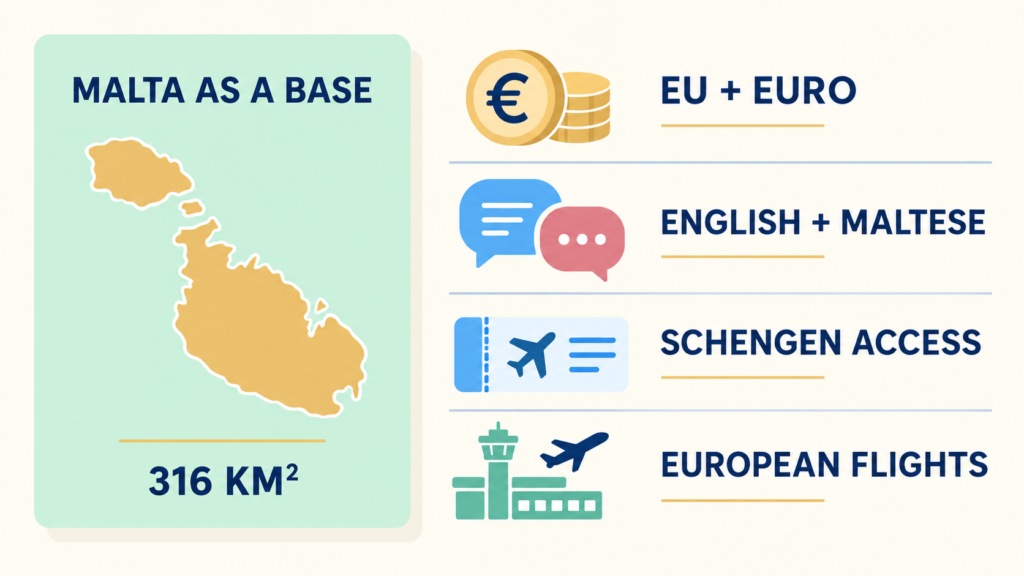
Malta is tiny by country standards, covering about 316 km², especially compared with places like Portugal or Brazil. The small size has a few obvious limits, but it can work in your favour. Most places you are likely to need, including the airport and main business districts, are never enormously far apart.
You also get the practical benefit of living in an EU country that uses the euro and is part of the Schengen Area. For someone who expects to travel around Europe regularly, I’d say that is one of Malta’s stronger USPs. Sicily is around 93 km north of the islands, and Malta International Airport has regular direct flights to destinations across Europe.
The language situation may be even more reassuring if you are moving from the UK. Maltese and English are the country’s official languages, so getting through daily life is far easier than in many Mediterranean destinations. You still move somewhere with its own language and culture, just without the same language barrier from the get-go.
Malta already has a sizeable international population, with non-Maltese citizens making up 31.1% of residents (at the end of 2025). That doesn’t guarantee settling in will be easy, though it shows how common moving there from abroad has become.
The reality is more complex than the tax-haven label
Calling Malta a tax haven makes it sound as though anyone can move there and suddenly pay very little tax. I was initially led to believe that too, so I’ll run through what’s actually going on.
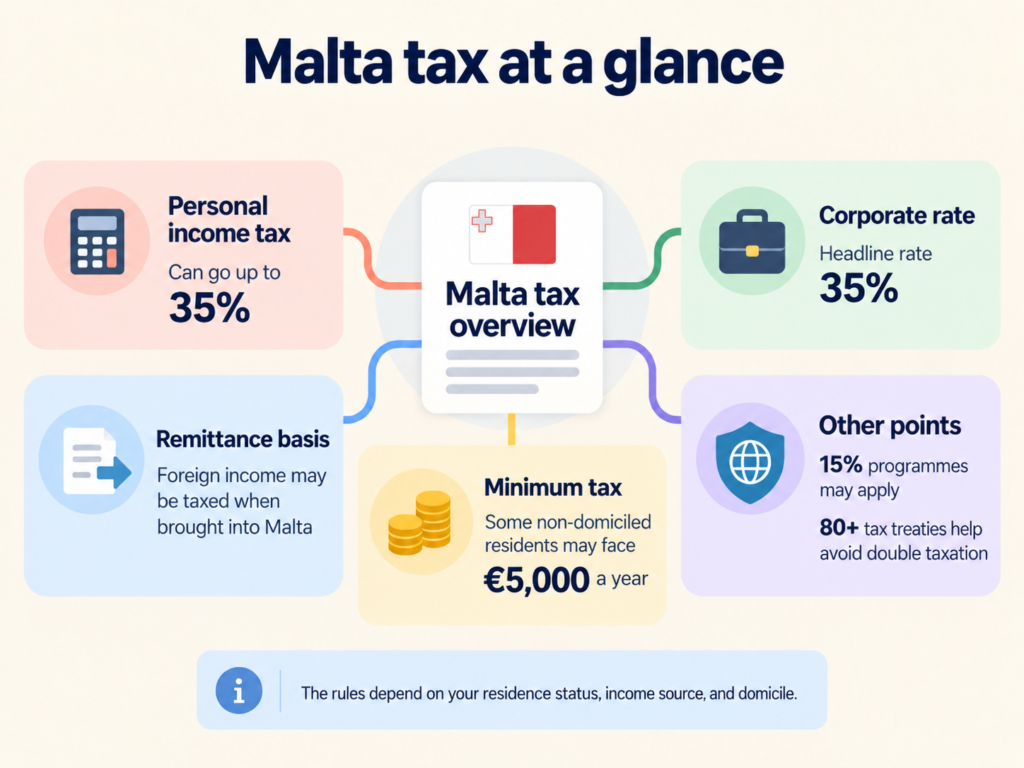
Personal income tax can still go as high as 35%, and Malta’s headline corporate rate is 35% too. Whether you get more favourable treatment depends on your residence status and where your income comes from. Malta can also take into account where your permanent home is considered to be when deciding which rules apply.
One rule I’d have on my radar is the remittance basis, which can apply if you live in Malta without being domiciled there (basically, without Malta being considered your permanent home). Income that comes from Malta is taxed there, and foreign income can be taxed if you bring it into the country. Foreign capital gains are treated differently and can usually stay outside Maltese tax even if you transfer the proceeds over.
Where the money comes from becomes important here, and you may need to show its source. Malta’s tax authority can treat money used for normal living expenses as income unless you can prove it came from existing capital or another non-income source.
Some non-domiciled residents can also face a minimum Maltese tax bill of €5,000 a year. The minimum generally doesn’t apply when foreign income is below €35,000, while special residence programmes follow separate rules.
The good news is that Malta has tax treaties in place with more than 80 countries worldwide. Depending on the country and type of income involved, they can help prevent the same income being taxed twice.
Certain residence programmes apply a 15% rate to qualifying foreign income brought into Malta, which is probably where some of the low-tax claims come from. The figure is accurate, but the conditions vary, so I’d fact-check any article or video promising a flat 15% tax bill within an inch of its life before taking it at face value.
Remote workers probably get the best deal
If your income comes from clients or an employer abroad, Malta starts to look pretty convincing. The Malta digital nomad visa, officially known as the Nomad Residence Permit, is one route worth exploring. The permit lets eligible non-EU, non-EEA and non-Swiss nationals live in the country while working remotely.
The main Malta digital nomad visa requirements start with income, and applicants currently need at least €42,000 gross per year. The permit initially runs for a year, and you can renew it three times, taking your total stay under the programme to four years if you continue meeting the requirements.
The tax treatment is where the digital nomad visa in Malta really started to pique my interest. Qualifying income from authorised remote work can be taxed at 10%, and you generally get a 12-month period before the tax starts to apply. Exactly how much you end up paying will depend on your own circumstances, including any tax you have already paid elsewhere.
Malta’s visa for digital nomads comes with a few restrictions you need to be wary of, too. You can’t use the permit to take a regular job with a Maltese employer, and self-employed applicants need to work with clients outside Malta. I’d factor private health insurance into the budget from the start too, since the nomad scheme doesn’t automatically give permit holders access to free Maltese healthcare.
Getting the Malta nomad visa doesn’t automatically make you a Maltese tax resident, either. The country treats your immigration status and tax residence separately, so the permit alone doesn’t guarantee that you’ll end up paying the 10% rate. If you’re considering Malta as a digital nomad, I’d check the permit requirements carefully before applying.
If you’re wondering how to apply for the Malta digital nomad visa, applications go through Residency Malta online. The official Malta digital nomad visa processing time is around 30 working days after Residency Malta confirms your payment, though an entry visa can add to the wait.
A glimpse of everyday life in Malta
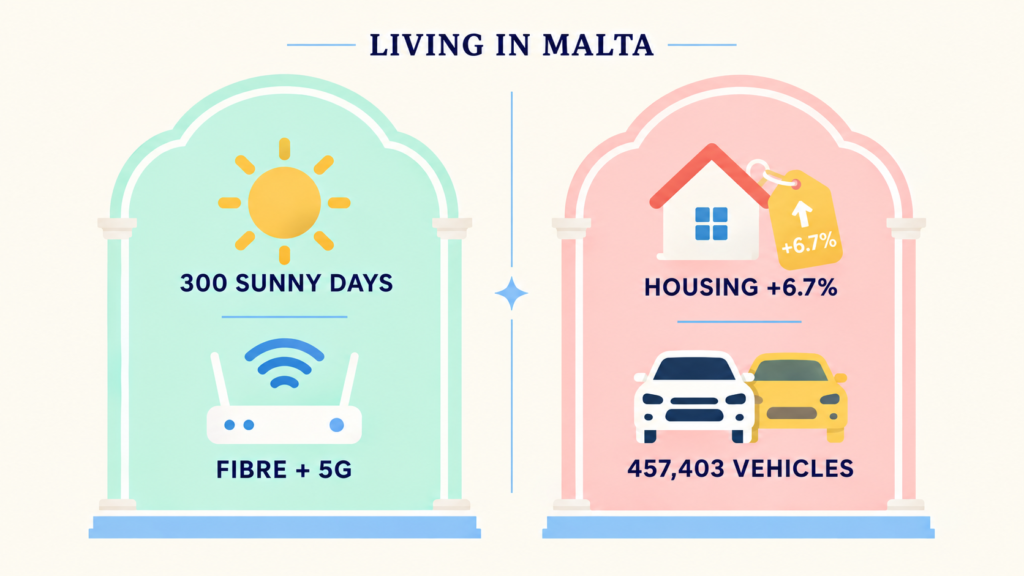
Malta gets around 300 sunny days a year according to its tourism authority, with hot summers and mild winters. If you’re trying to get away from long stretches of grey British weather, I can see the attraction. However, after the heatwave we endured here, I don’t have many nice words left for extreme heat.
That brings me to what the warmer months there can actually feel like, because summer deserves a bit more caution. Official climate records show Malta has become warmer over time. Based on that, anyone who isn’t a fan of the heat may find July and August harder to handle.
As far as events are concerned, there seems to be plenty going on throughout the year. The annual Malta Marathon is one good example. The 2026 race took place on 22 February and finished in Sliema after a route through several parts of the island. I like that Malta doesn’t seem to go quiet once summer is over, as local festas and bigger cultural events carry on through autumn and into December.
For anyone living in Malta as a digital nomad, good internet is something you can’t really compromise on. The country has widespread fibre coverage and nationwide 5G, so staying connected shouldn’t be much of an issue.
The small size comes with a few trade-offs
Malta may look fairly spread out, but the numbers tell a different story once you see how many people and vehicles fit into 316 km². By the end of 2025, the country had more than 588,000 residents. Sliema alone had a population density above 18,000 people per km², which shows how crowded some areas can get.
Housing is another area where the small-island idea can lose some of its charm. Residential property prices were 6.7% higher in the first quarter of 2026 than a year earlier, and apartment prices rose by 6.9% over the same period. I wouldn’t describe Malta as a cheap place to move without checking the exact town and type of property first.
Rent can vary quite a bit depending on where you settle and what you’re looking for. Areas around Sliema and St Julian’s can command noticeably higher prices, especially where demand from international residents is strong. Someone earning a foreign salary may have a very different experience from someone relying on local wages.
Transport is another rather odd side of living somewhere so compact, because short distances don’t always mean quick journeys. Traffic can still slow things down, considering there were 457,403 licensed vehicles recorded at the end of 2025.
Residents with a personalised Tallinja card can use regular bus services without paying a fare, so owning a car is not the only option. I still wouldn’t assume that living on a small island means every journey will be quick.
How easy is it to move to Malta?
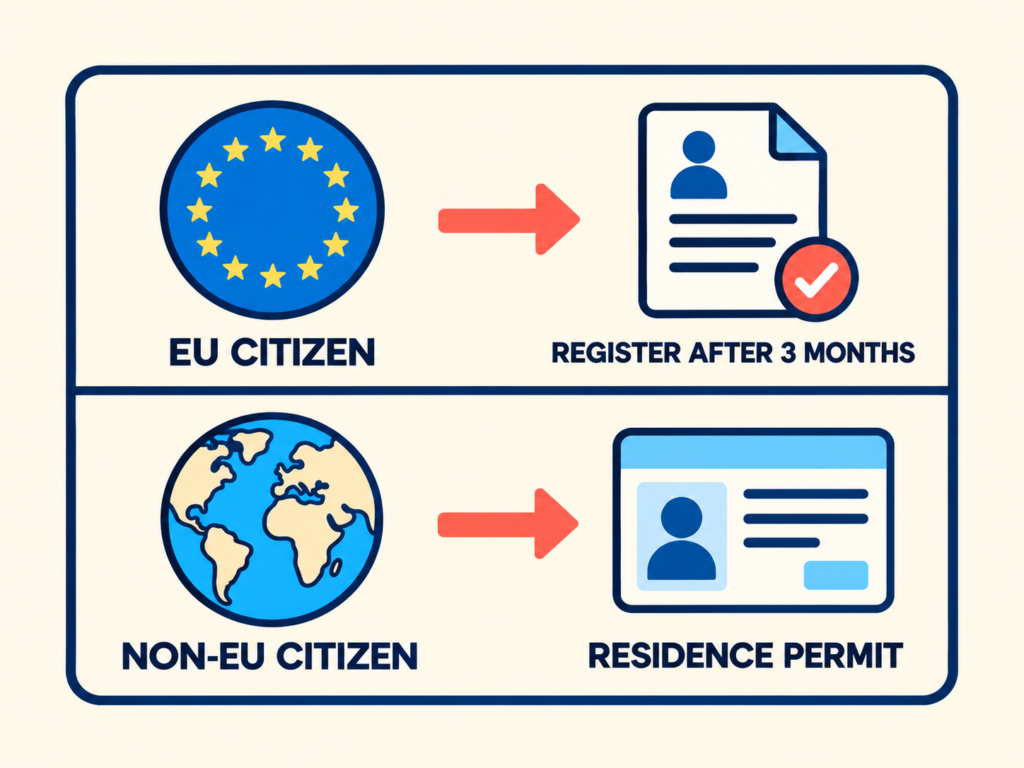
EU citizens have the simplest route because free-movement rules apply. If you plan to stay for more than three months for work, self-employment or another qualifying reason, you will generally need to register your residence.
Unfortunately, British citizens no longer have that automatic right after Brexit. A UK national moving to Malta for a job will usually need the appropriate work and residence permission, which for many non-EU employees means applying for a Single Permit.
For wealthier non-EU applicants, there’s also the Malta Permanent Residence Programme. The financial requirements are steep by many standards, so the programme is aimed at a very different type of applicant from the remote-worker routes I mentioned above.
One thing I’d clear up here is that permanent residence doesn’t mean you’re buying Maltese or EU citizenship. Malta’s investor-citizenship scheme was ruled contrary to EU law by the Court of Justice of the European Union in April 2025, and the current residence programme does not give you an EU passport.
So, is Malta worth the move?
All things considered, Malta can work particularly well for international earners looking for an English-speaking EU base. Many remote workers make use of the dedicated route by applying for Malta digital nomad visas. Malta is also undeniably easy on the eyes, owing to its historic towns and Mediterranean coastline.
You may not feel quite as thrilled about the prospects if affordable housing and a quieter, less crowded setting are priorities. Trade-offs and all, Malta is an excellent option provided the benefits outweigh the downsides for you.